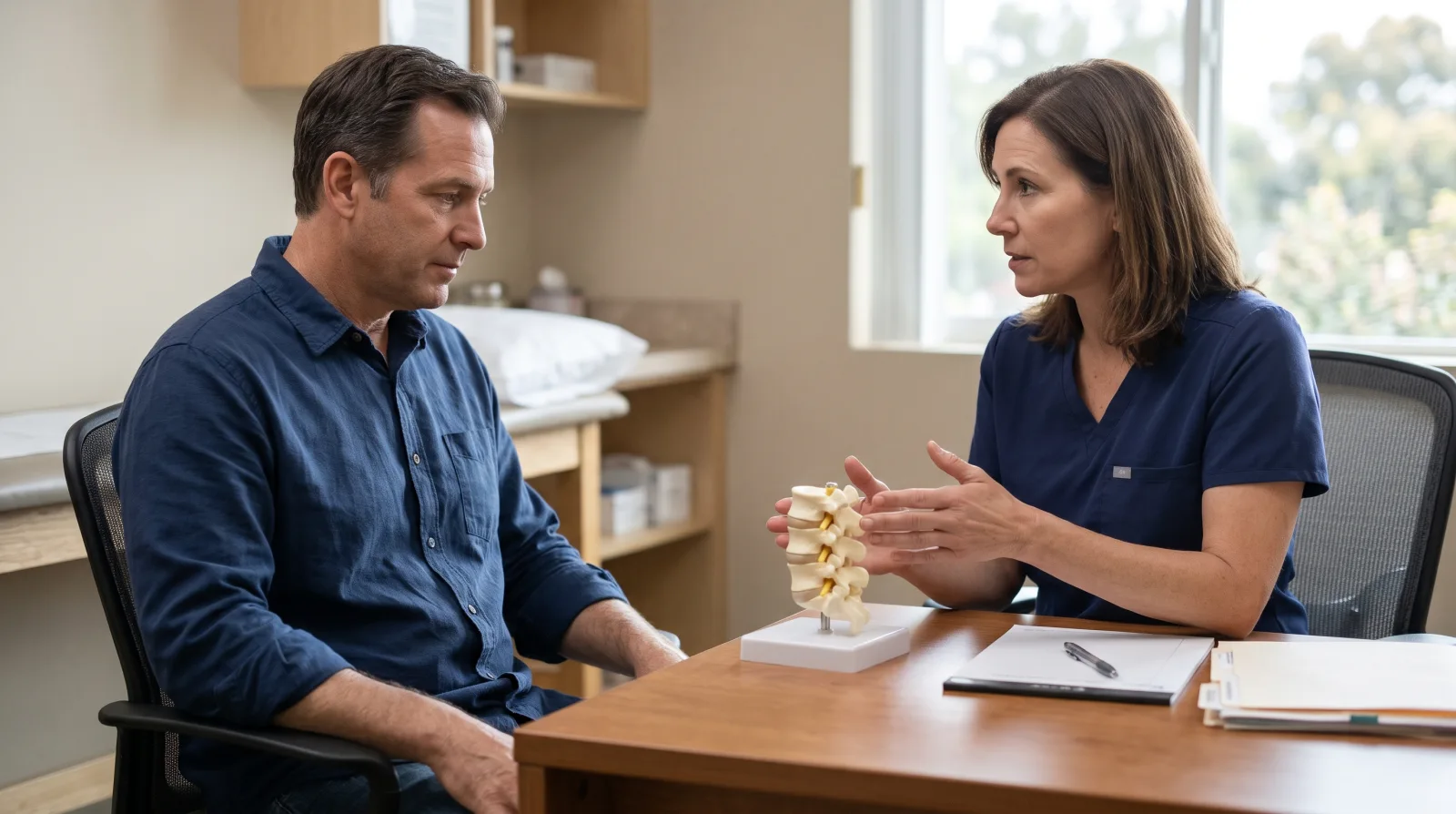
Bring a short account of an ordinary walk: what you were doing, where and when your leg first felt different, what made you slow down or stop, and what happened while you rested. A familiar landmark is as useful to us as a distance in feet. At your first Bhalla Spine visit in Long Beach, we want to understand what walking is like for you. Bring what you noticed, even if you’re unsure what caused it.
Which changes should not wait for an appointment?
Possible sudden loss of blood flow. Call 911 if a leg or foot suddenly becomes severely painful, especially if it also feels cold, looks pale, goes numb, or becomes hard to move. Call 911 for sudden coldness with loss of feeling, even if pain is mild. If this happens during a walk, stop and get help right away. Don’t finish the walk or try to check your own pulse first. [1] [2]
Possible pressure on the nerves that control the bladder and bowel. If you have back or leg symptoms, go to an emergency department now for new trouble starting urination or feeling urine pass, new loss of bladder or bowel control, or new numbness around the genitals or anus. Have someone else take you if you can travel safely. Otherwise, call 911. These can be warning signs of cauda equina syndrome. [3] [4]
Seek urgent medical care right away for severe or rapidly worsening leg weakness. Go to an emergency department now if this weakness affects both legs along with back or leg symptoms. The UK specialist pathway includes this pattern among the warning signs clinicians assess for cauda equina syndrome. [4] [5]
If you have ongoing pain in your foot or toes while resting, especially in bed, or a foot sore that isn’t healing, call your primary care clinician or a vascular specialist promptly. Bring up either concern before a routine spine visit. [6]
What should I write down about an ordinary walk?
Use one column below for each day you remember. Pick something you were going to do anyway: taking out the recycling, crossing a parking lot, or getting from one room to another. If you’ve noticed a difference across several days, include it. If you remember only one outing, bring that one. Don’t take an extra walk, push through symptoms, or put off care to fill the page.
Your walking and rest diary
| What to jot down | Day or date: ______ | Day or date: ______ | Day or date: ______ |
|---|---|---|---|
| Activity, pace, and ground; any usual walking aid | |||
| First symptom: about how many minutes, how far, or at what landmark? | |||
| Where did you feel it, on which side, and what did it feel like? | |||
| Where did you slow down or stop, and why? | |||
| How did you rest: standing, sitting, leaning, or something else? | |||
| About how long until it eased? What, if anything, remained? | |||
| What happened to the task: finished, shortened, skipped, or needed help? |
Start with the errand. A trip across a store might involve a walk from the car, several stops at shelves, and a wait at the register. Which part were you doing when the feeling began? If you were already standing in line, say that. We don’t need a single distance for an outing that wasn’t one continuous walk. [6] [7]
Use your own words for the feeling. An ache, tightness, heaviness, tingling, or tired legs are all worth mentioning. Name the spot as best you can: buttock, thigh, shin, calf, foot, or toes. If both legs bothered you, note whether they felt alike. If it’s hard to put the feeling into words, point to the spot at the visit and tell us what it interrupted. [6] [7]
Separate the first change from the stop. You might notice something well before you decide to sit down. Or you might stop because you’ve reached the door, not because your legs made you stop. Those are different answers. If you finished a task at a slower pace, write that rather than recording only that you finished.
One fictional example: three days from the same diary
- Monday, returning library books: Walked at my usual pace on a level sidewalk. My right calf felt heavy near the first corner, about a block from the start. I stopped at the book drop and stood there. The heaviness eased after a few minutes. I finished the errand.
- Wednesday, putting groceries away: Made several short trips between the car and kitchen, carrying one bag at a time. Neither leg bothered me. I didn’t need a break.
- Saturday, shopping: The parking lot sloped up toward the store. My right calf tightened halfway to the entrance. I sat on the bench by the door. It felt better after a few minutes but still ached a little inside, so I bought fewer things than planned.
One sentence to bring: “My right calf felt heavy or tight on two walks this week and eased after a few minutes of rest, but short trips between the car and kitchen felt fine.”
For your own sentence, keep the parts that fit: “During [ordinary task], I felt [what and where] after about [time or landmark]; when I [how I rested], [what changed and how soon], so I [what happened to the task].” Leave out anything you don’t remember.
Does it matter how I rested?
Yes. Tell us what rest actually looked like. Did you stop walking but stay upright? Sit on a chair? Lean over a counter while waiting? If you were already using a shopping cart or walker, say whether you were leaning on it or simply using it to carry things. There’s no need to repeat the trip without your usual support. [6] [7]
What matters is the order of events. If you stood for a while and then sat down, did you notice any change before you sat? If you can’t separate the two, write “stood, then sat. I’m unsure when it eased.” Also distinguish started to feel better from felt back to usual. You may remember that you were comfortable by the time your ride arrived without knowing how many minutes passed. That’s a useful answer. [6] [7]
Posture gives us another detail to ask about. In a small study comparing people with spinal narrowing and people with artery disease, individual clues such as where the discomfort occurred or whether sitting helped were weak guides on their own. Feeling better leaning forward does not rule out a circulation problem. If you’ve heard the term stenosis, our lumbar stenosis guide explains what the word means. You don’t need to decide whether it belongs in your diary. [7] [8]
What if my walking is different from day to day?
Give us the range rather than averaging it away. If one outing stands out as unusually difficult, mark it that way. Then describe what you can usually do. Consider whether the trips themselves were different: a gentle slope instead of level ground, a hurried crossing instead of browsing, or one long stretch instead of short trips with a chance to sit between them. Don’t change your pace or route to make a comparison. [6]
Include the work you’ve quietly stopped doing. Getting through a shopping trip by picking up only a few items is different from being able to shop as before. So is completing a shift because someone else took over the walking. If you no longer do an activity, leave the distance blank and tell us what you’ve changed. A day without symptoms may have been a day without the walk that usually bothers you. [6]
At the top of the page, add roughly when you first noticed the problem and what has changed since. Think of a familiar task you did before then: can you still do it in one trip, does it take breaks, or have you handed it to someone else? If your walking has stayed much the same, say so. An approximate month or a season is fine; we’re interested in the change, not in testing your memory. [6]
What should I tell a spine physician about circulation?
Tell us if discomfort returns at about the same point on a familiar walk, what happens when you simply stop moving, and whether the feeling ever begins when you haven’t been walking at all. Pain that starts while you’re resting is different from walking pain that takes a while to fade. Say which you mean. Leg artery disease, also called peripheral artery disease or PAD, doesn’t always feel like a calf cramp. Fatigue or numbness with walking can be relevant, too. If a familiar feeling comes on while walking and eases with rest, describe it as part of that pattern. New numbness in the areas described in the emergency section needs immediate care. [6] [3]
Bring up any history of a slow-healing toe or foot sore, including which foot and whether anyone has treated it. Tell us about known artery disease, past procedures to improve blood flow, diabetes, kidney disease, high blood pressure or cholesterol, and current or past smoking. If you have a report from a previous circulation visit, bring it if it’s handy. You don’t have to interpret it or decide whether it explains this particular walk. [6]
It’s reasonable to ask about blood flow even if an earlier back report mentioned narrowing. Researchers studying people with confirmed lumbar spinal stenosis found that some also had PAD, including people who didn’t already know they had it. That doesn’t tell us the cause of your symptoms. It does explain why we want to hear about your feet and your health history as well as your back. A clinician can look at your feet and check pulses as part of the assessment; that part is not homework. [6] [9]
What else should I bring to my first appointment?
Put the diary or your one-sentence summary somewhere easy to reach. A paper note, a note on your phone, or a few words you can read aloud will do. If someone regularly walks with you, you can ask what they’ve noticed about your pace or stops. Their observation can sit alongside yours: they may remember where you paused, while only you know what you felt. [10]
- A current medicine list. Include prescriptions, over-the-counter medicines, vitamins, and supplements, with the dose and how often you take each. Note medication allergies or reactions. If you’ve already tried something for the leg symptoms, tell us what changed, if anything. [10]
- Relevant records you already have. Prior visit notes, reports, and available images can provide context. If you remember an evaluation but don’t have the record, jot down roughly when it happened and what you were told. Don’t postpone your visit to put together a perfect file. [10]
- One activity you want help with. Choose something that matters to you, whether it’s shopping for yourself or getting from your work area to the break room. Tell us which part is hard. A goal in your own words gives us something concrete to discuss. [10]
At the visit, start with the outing that best shows why you came. If your legs feel fine while you’re sitting in the office, you can still describe what changed on the walk. We can compare that account with the exam, which may include checking strength and feeling in your legs and looking for circulation clues. Before you leave, ask what the findings help explain and what remains uncertain. [6] [7]
For a routine first visit, request an appointment with Dr. Bhalla through Commons Clinic or call (562) 427-8119. Use the form for routine care. For the emergency symptoms above, get help immediately. Our contact page has the Long Beach office details. If getting from the car to the office is itself a concern, ask about access when you call.
If a word from your visit is unfamiliar, start with our overview of the lower back. Our lumbar radiculopathy guide explains irritation of a nerve in the lower back. If your physician mentions sciatica, our Long Beach sciatica guide explains the term and how to describe symptoms that travel down a leg.
If your next question is about care without an operation, read about our non-surgical care options. If you’ve already completed rehabilitation and walking is still limited, Khurana Spine’s guide to leg pain after rehabilitation explains when to return for reassessment.
Questions to ask your physician
Pick the question that matters most to you and leave space beside it for the answer. [10]
- What do you notice when you compare my walking notes with today’s exam?
- Could blood flow be part of the problem, and should another clinician be involved?
- What can I safely do about the everyday task I’m struggling with?
- What changes should I report, to whom, and how soon?
- If the cause is still unclear, what is our next step?
Learn More
- Society for Vascular Surgery. Acute Limb Ischemia.
- National Heart, Lung, and Blood Institute. Facts About Peripheral Artery Disease. See “When to call 911.”
- Wiseman D. Cauda Equina Syndrome. American Association of Neurological Surgeons. April 5, 2024.
- NHS England, Getting It Right First Time. National Suspected Cauda Equina Syndrome Pathway. March 2026.
- American Association of Neurological Surgeons. Herniated Disc.
- Gornik HL, Aronow HD, Goodney PP, et al. 2024 ACC/AHA multisociety guideline for the management of lower extremity peripheral artery disease. Circulation. 2024;149:e1313–e1410. DOI: 10.1161/CIR.0000000000001251. PMID: 38743805.
- Sekiguchi M. The Essence of Clinical Practice Guidelines for Lumbar Spinal Stenosis, 2021: 2. Diagnosis and Evaluation. Spine Surgery and Related Research. 2023;7:300–305. DOI: 10.22603/ssrr.2022-0080. PMID: 37636148.
- Nadeau M, Rosas-Arellano MP, Gurr KR, et al. The reliability of differentiating neurogenic claudication from vascular claudication based on symptomatic presentation. Canadian Journal of Surgery. 2013;56:372–377. DOI: 10.1503/cjs.016512. PMID: 24284143.
- Uesugi K, Sekiguchi M, Kikuchi S, et al. Lumbar spinal stenosis associated with peripheral arterial disease: a prospective multicenter observational study. Journal of Orthopaedic Science. 2012;17:673–681. DOI: 10.1007/s00776-012-0311-z. PMID: 23053583.
- American Academy of Orthopaedic Surgeons. Getting the Most Out of Your Visit With an Orthopaedic Surgeon. OrthoInfo.