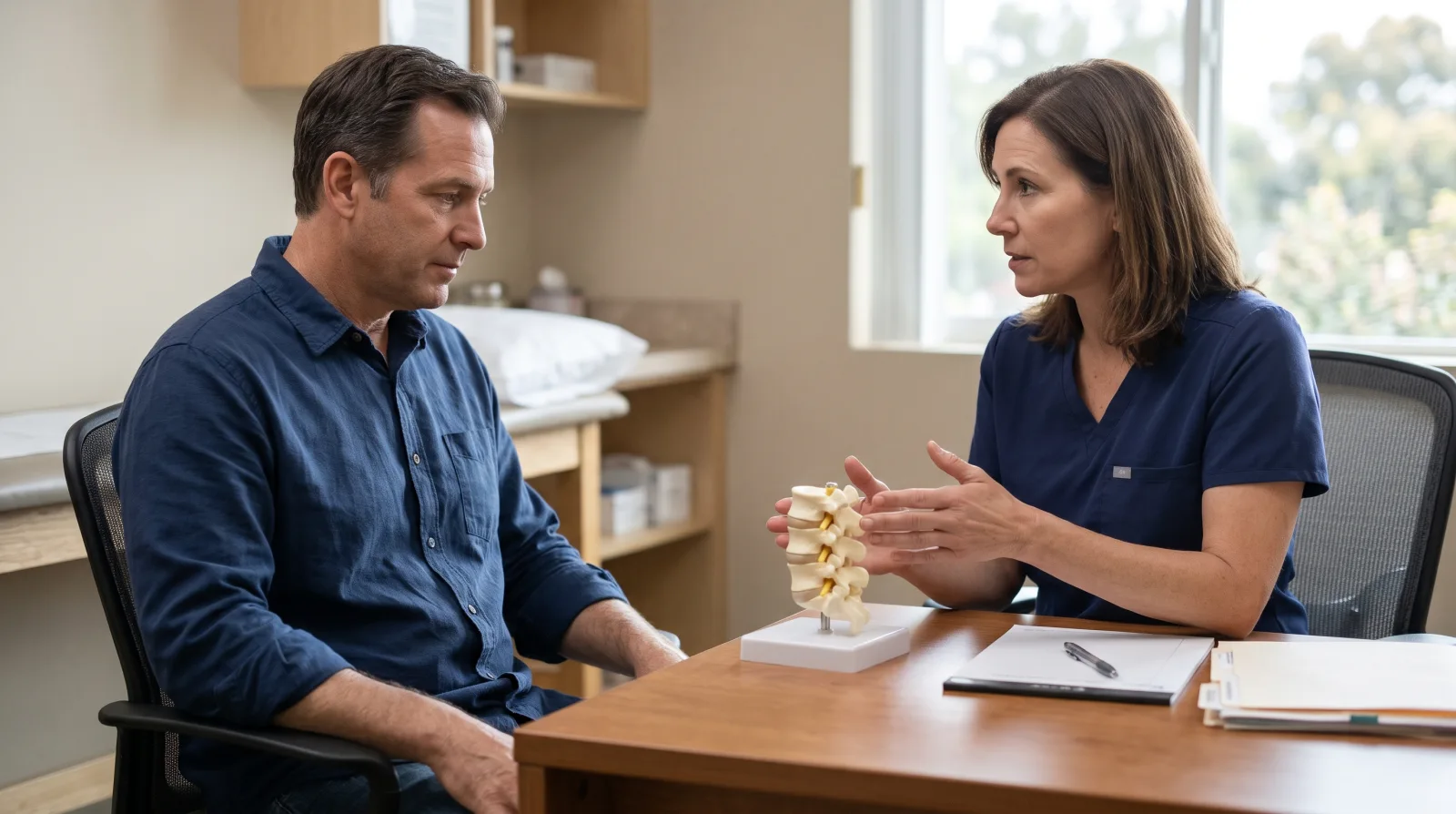
Ask the surgeon who recommended surgery, “How long is it safe for me to wait while I get a second opinion?” Ask both clinicians which symptom they expect surgery to improve, which findings on your exam and scans help explain that symptom, and which level of your spine they would treat. Ask each clinician why they would add fusion or leave it out, and which symptoms might persist even if surgery goes well. [1]
When to get emergency help: If you have lower-back or leg symptoms, go to an emergency department now if you notice any of these changes: new trouble starting to urinate or emptying your bladder or new loss of bladder or bowel control, changed feeling around your genitals, anus, buttocks or inner thighs, or leg weakness that is new and severe or is getting worse quickly. Do not wait for all of these symptoms, an appointment or a callback. If this may be a life-threatening emergency, or if you are unsure you can travel safely, call 911. If you can travel safely, have someone else take you. [2]
Start with the activity you want back
At Bhalla Spine, we start the discussion with what stops you on an ordinary day. Maybe you can walk to the grocery store but need to sit down before you can shop. Is it pain down one leg that makes you stop? Do both legs feel heavy? Or is the hardest part standing at the counter afterward because your back aches? Those are different problems to put to a surgeon.
Write one sentence: “The activity I most want back is ______. Right now, I can ______ before ______ makes me stop.” Describe what you can already do rather than pushing yourself to find a limit. If you have both leg and back symptoms, say which matters more to you. Then ask each clinician to point to the part of the scan that fits your description and explain what your examination adds. [3]
You’re not there to defend the first recommendation or persuade someone to disagree. You’re there to understand it. Preparing for that conversation is separate from deciding whether you’re a candidate or giving consent to an operation.
What is the reason to decompress?
Decompression means making more room for nerves. In lumbar stenosis, the space around nerves in the lower back has narrowed. Standing or walking can bring on leg symptoms that ease with sitting. One type of decompression, a laminectomy, removes bone or thickened tissue that is pressing on the nerves. For stenosis surgery, leg pain tends to improve more than back pain does. That distinction matters if back pain is the main reason you’re considering surgery. [3]
Ask the clinician to show you where the nerve is crowded and which symptom that could explain. If the report mentions three levels but the surgeon proposes treating one, ask why that one stands out. If the proposed operation covers several levels, work through them one at a time. You should be able to write down the aim at each level without having to interpret the scan yourself.
What is the separate reason to fuse?
Fusion aims to make two or more spinal bones heal together so they no longer move against each other. A bone graft helps them join; screws or rods may hold them steady while the bone grows. The question is not just whether a nerve needs room. It’s whether the bones at that level need lasting support. [4]
We separate two possible explanations: the level is unstable now, or freeing the nerve would require removing enough support to make it unstable. Ask which concern applies. If the surgeon sees a slip, ask whether the bones are simply out of line on one image or whether they move too much between positions. X-rays taken while bending forward and backward can help assess motion. If the concern is what surgery would remove, ask the surgeon to point to the supporting joint and explain whether another approach could preserve it. [3] [5]
For stenosis without a slipped vertebra, a U.S. neurosurgical guideline advises against adding fusion when there is no deformity or instability and the decompression is not expected to create instability. That guidance has a specific scope. If you’ve been given a different diagnosis, ask for the reasoning and evidence for that diagnosis. [5]
Records checklist for the second visit
Bring what you have. If something is missing, tell the office what it is and where it was done. This is a list of existing records to gather, not a list of new tests to arrange. [6] [7]
- The first recommendation. Ask for the visit note with the proposed operation, the exact levels, the reason for fusion and the suggested timing. Mark any word you would like explained.
- Images and written reports. Request the actual MRI, CT or X-ray images as well as the reports. Include earlier studies and any standing or bending X-rays already taken. Ask whether the second office accepts a disc or secure transfer, and confirm the images arrived. [7]
- A short symptom timeline. Note when the problem began, which side is affected, what has changed and which activity you miss most. Separate pain, numbness and weakness rather than listing them all as “back trouble.” [6]
- Prior care and results. List what you tried, for how long, what it let you do and how long that change lasted. “I could finish shopping during therapy, but standing still was still difficult” tells us more than “therapy helped.”
- Medicines and health history. Include prescriptions, nonprescription medicines, vitamins, supplements, allergies and major health conditions. Bring the list for review, not to make changes on your own. [6]
- Records from any earlier spine operation. Bring operative reports and discharge instructions if available. Note what improved afterward, what never changed and what is new. Our guide to revision spine surgery after an earlier operation explains why the original records matter.
What the studies can tell us about adding fusion
Three randomized trials asked whether adding fusion helped people who were already having decompression for stenosis. None compared surgery with continued nonsurgical care. A degenerative slip, also called degenerative spondylolisthesis, means one spinal bone has shifted forward relative to the next as the joints and discs have changed over time. The studies did not all enroll the same people or use the same main measure of success. [8] [9]
Nordsten-DS: a slip at the narrowed level. The Norwegian trial included 267 adults with leg symptoms, MRI-confirmed stenosis and a slip of at least 3 mm at that level on a standing X-ray. At five years, an estimated 63% in each group had improved by at least 30% on a questionnaire about disability. The study ruled out decompression alone doing worse by the researchers’ preset margin of 15 percentage points; that does not prove the operations identical. By five years, 16% had another lower-back operation after decompression alone, compared with 18% after fusion. [8]
The Swedish trial: stenosis with or without a slip. This trial included 247 adults aged 50–80 with narrowing at one or two neighboring levels. At two years, adding fusion did not produce a statistically better disability score or six-minute walking distance. Fusion involved more bleeding and a longer hospital stay. The researchers did not use bending X-rays to assess motion, so the study cannot settle a question about a particular moving slip. A later report from the same trial also found no significant difference in disability scores at five years. [9] [10]
SLIP: a smaller trial with a different result. This U.S. trial enrolled 66 adults aged 50–80 with stenosis and a stable, low-grade slip. At two years, the fusion group gained 5.7 points more on a general physical-health score, the trial’s main measure. The difference on the back-related disability questionnaire was not statistically significant. Over four years, 14% had another operation after fusion versus 34% after decompression alone. Only 68% completed four-year follow-up. The main physical-health score difference just met the study’s threshold for statistical significance. The reoperation finding is worth discussing, but it is not a personal risk estimate. [11]
An AO Spine expert panel says no single rule fits everyone with a degenerative spinal slip. Reviewing your scans for signs of instability helps your surgeon choose between decompression alone and decompression with fusion. [12]
A Norwegian study included 2,252 people: 236 took part in the randomized Nordsten trial within the registry, and the rest were followed through the registry without random assignment. Differences between patients could still have influenced the results. At 12 months, the researchers did not find that the benefit of adding fusion varied across the patient groups they had chosen to compare in advance. That does not prove the benefit is the same for every group. [13]
If your recommendation concerns a prior fusion, a major spinal curve, a recent injury or back pain without the studied leg symptoms, don’t borrow these percentages. Nordsten-DS, for example, excluded previous surgery at the slipped level, previous mid- or lower-back fusion, and severe narrowing at the opening where a nerve exits, which the researchers defined as a nerve root visibly deformed inside the opening. A useful question is: Which part of my history makes this a different decision? [8]
Compare the risks, recovery and option of waiting
Ask about the downsides of each practical option, not just the proposed operation. With fusion, risks include infection, bleeding, nerve injury and blood clots. There is also a risk specific to the goal of fusion: the bones may not grow together solidly, and another operation may be needed. Bone healing can take months. Going home, managing a flight of stairs and being ready for a full shift at work are different milestones; ask about each one that matters to you. [1] [4]
Tell us what recovery would actually require at home. If you live alone upstairs or help someone else bathe and dress, say so. Ask what help to arrange, who will check your progress and what they will look for before clearing you for work or driving. If either clinician gives you a time range, write down which milestone it describes. [1]
If waiting is medically reasonable, give that option its own plan. What would you track? When would you be examined again? What change would bring that review forward? If another course of nonsurgical spine care is suggested, ask what would be different from care you have already tried and how you would tell whether it was worthwhile. [1]
Your two-opinion comparison worksheet
Use the same activity in both columns. Write “not discussed” rather than filling in an answer from memory. A blank beside an important question tells you exactly what to ask next.
| What to compare | First opinion | Second opinion |
|---|---|---|
| My main symptom and the activity I want back | ______ | ______ |
| Finding on exam or imaging; exact level and side | ______ | ______ |
| Aim of decompression: which nerve needs room? | ______ | ______ |
| Reason to fuse, or not fuse, at each proposed level | ______ | ______ |
| What is most likely to improve? What may persist? | ______ | ______ |
| Alternatives, including waiting if appropriate | ______ | ______ |
| Main risks, including the possibility of another operation | ______ | ______ |
| Recovery: help at home, work, driving and follow-up | ______ | ______ |
| Timing: safe interval, what would change it and whom to contact | ______ | ______ |
Fictional example — not a patient record or a recommendation. Jo wants to walk from the parking lot to a granddaughter’s softball field without stopping because of leg pain. Jo also has a backache while washing dishes. Here is part of Jo’s worksheet:
| Jo’s notes | First opinion | Second opinion |
|---|---|---|
| Symptom, level and aim | Narrowing at L4–L5 may explain the leg pain. Make room for the nerve. | Same level and walking goal. The backache is a less certain target. |
| Why add fusion? | Concern that freeing the nerve would remove too much of a supporting joint. Proposes fusion for support. | Thinks the nerve could be freed while keeping more of that joint. Would discuss decompression alone. |
| What is still missing? | Ask how much joint would need to come out and what fusion would add to recovery. | Ask how stability would be checked and what finding would change the plan. |
Jo’s next question is not which surgeon is right about the pain. They agree about the walking problem. The disagreement is how much joint must be removed. Asking both to show that on the same images gives Jo something specific to discuss. In your own notes, circle the first row where the opinions diverge. If it’s the diagnosis rather than the operation, start there before comparing recovery times.
Read about lumbar stenosis and symptoms that affect walking. If disc replacement came up in either visit, our disc replacement versus fusion guide explains that separate comparison.
For a routine second opinion, request an appointment with Dr. Bhalla through Commons Clinic or call (562) 427-8119. See office contact details. [14]
Questions to ask your physician
- Can you show me the finding and level that best explain the symptom I most want treated?
- What would decompression do? What separate problem would fusion address?
- Which symptom is most likely to improve, and which might I still have?
- Which study best fits me, and what important difference limits the comparison?
- If I choose not to schedule surgery now, what follow-up plan makes sense?
- What risk or recovery need should I plan for, and what would change your recommendation or its timing?
Learn More
- MedlinePlus. Questions to ask your surgeon about spinal surgery.
- American Association of Neurological Surgeons. Cauda Equina Syndrome. NHS England, Getting It Right First Time. National Suspected Cauda Equina Syndrome Pathway.
- American Academy of Orthopaedic Surgeons (AAOS). Lumbar spinal stenosis.
- AAOS. Spinal fusion: purpose, risks and recovery.
- Resnick et al. Guideline: lumbar fusion for stenosis without spondylolisthesis. DOI: 10.3171/2014.4.SPINE14275; PMID: 24980587.
- MedlinePlus. Make the most of your doctor visit.
- RadiologyInfo. How to obtain and share your medical images.
- Kgomotso et al. Nordsten-DS five-year randomized follow-up. DOI: 10.1136/bmj-2024-079771; PMID: 39111800.
- Försth et al. Swedish randomized trial of fusion for lumbar stenosis. DOI: 10.1056/NEJMoa1513721; PMID: 27074066.
- Karlsson et al. Swedish trial: five-year clinical results. DOI: 10.1302/0301-620X.106B7.BJJ-2023-1160.R2; PMID: 38945544.
- Ghogawala et al. SLIP randomized trial. DOI: 10.1056/NEJMoa1508788; PMID: 27074067.
- Martin et al. AO Spine recommendations for degenerative spondylolisthesis. DOI: 10.1177/21925682251336755; PMID: 40498575. Title correction, PMID: 40900211.
- Hansford et al. Comparison across patient groups using Norwegian registry data. DOI: 10.7326/ANNALS-25-05260; PMID: 42970804.
- Bhalla Spine. Contact, appointment requests and after-hours support.