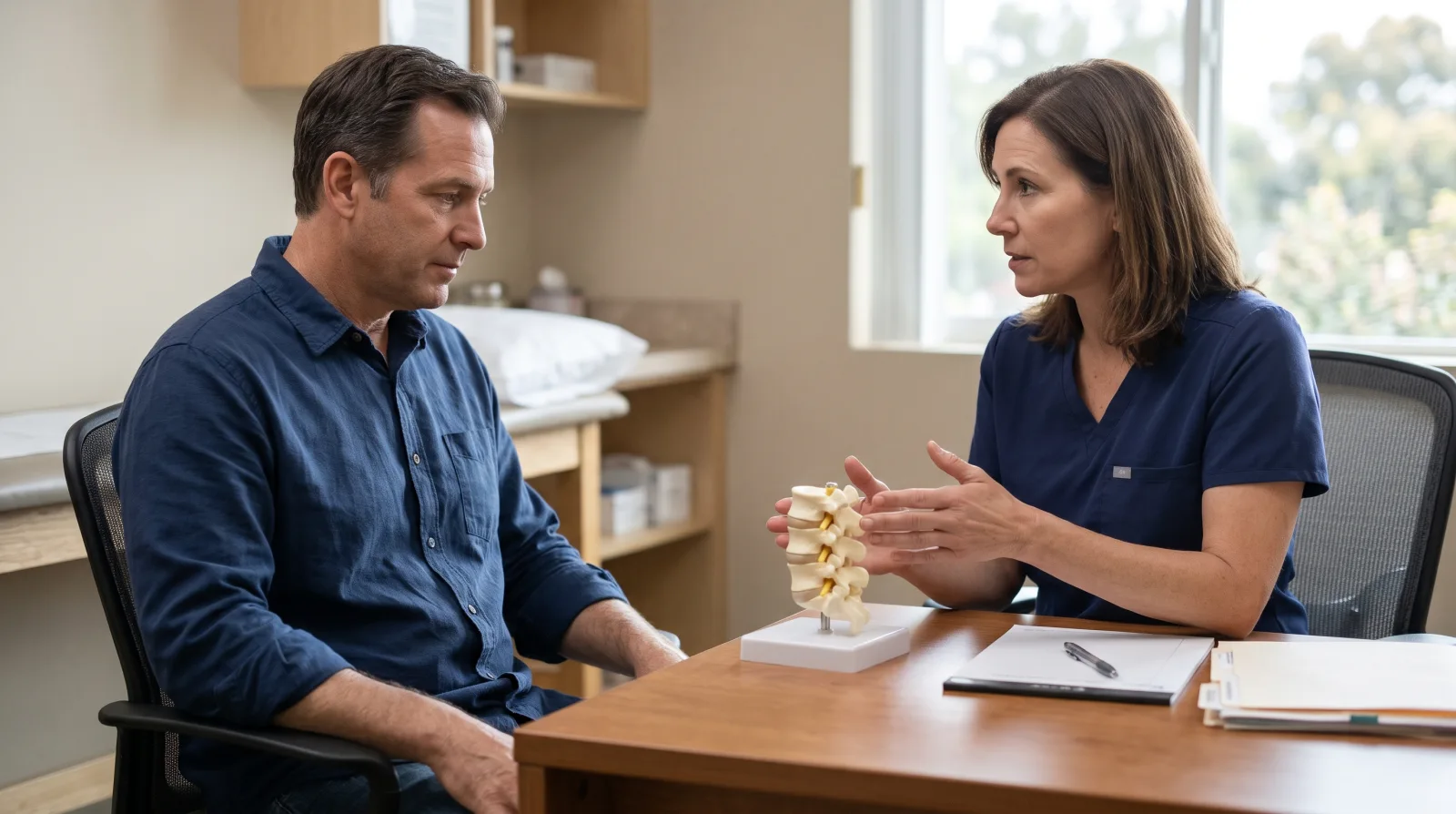
Disc replacement keeps some movement between two spinal bones. Fusion is meant to stop movement there when stability matters more. The first question, though, is what problem would an operation solve? In the neck, the goal may be to free a nerve or protect the spinal cord. In the lower back, replacement is an option for a narrower group whose pain can be traced to a damaged disc. Sometimes neither operation is the best next step. [1] [2]
For a routine visit, request a consultation with us or call our Long Beach office at (562) 427-8119. The consultation address is 3610 Long Beach Blvd, Suite 202, Long Beach, CA 90807. Office contact details and directions
Which symptoms should not wait for an appointment?
Go to an emergency department now for new inability to empty your bladder, new loss of bladder or bowel control, or new numbness around the genitals, buttocks or anus, particularly with back or leg symptoms. These can signal serious compression of the nerves in the lower spine. Do not wait for all the signs to appear or for a booking response. Call 911 for sudden inability to walk or move a limb, severe trouble breathing or severe chest pain. [3] [4]
What can I bring that an MRI cannot tell you?
Tell us what stops you first on an ordinary day. Is it arm pain when you reach for a shelf, a hand that no longer grips a key, back pain halfway through dinner, or leg pain before you reach the bus stop? Note where it starts, where it travels and whether it is changing. Describe weakness separately from pain. A short account of something you could do last month but cannot do now is useful.
Bring the images and report if available. List treatments you tried, for how long, and what each one let you do. A scan needs context: in a study of 98 people without back pain, about half had a lumbar disc bulge on MRI. Ask which part of your exam links the finding to your symptoms. [5]
Three lines to fill in before the visit:
- The activity I most want back is ______. Right now I can manage ______.
- The treatment that helped most was ______. What it did not change was ______.
- Even if the operation helped my pain, I would hesitate if ______.
If the problem is in my neck, what would each operation do?
A nerve compressed in the neck can cause pain down an arm, numbness or weakness. This is called cervical radiculopathy. Pressure on the spinal cord can instead affect tasks such as fastening clothes or walking steadily. This is called cervical myelopathy. The distinction changes the goal: easing arm pain is different from trying to prevent further loss of hand or walking function. Ask which findings on your examination point to the nerve, the cord or both. [6] [7]
For either cervical disc replacement or anterior cervical discectomy and fusion (ACDF), the surgeon approaches from the front of the neck and removes the problem disc and any bone spurs that need to come out. Replacement puts a moving implant in the space. ACDF uses bone graft, often with a spacer and screws, so the bones can grow together. For some pinched nerves, a third option is to make room from behind without replacing the disc or fusing the bones. [1]
The FDA’s original Mobi-C approval P110009 covers two neighboring disc spaces between C3 and C7 in people whose bones have finished growing. It is for persistent nerve-root symptoms, with or without neck pain, or cord symptoms from disease at those spaces. Imaging must show a matching herniation, bone spurs or loss of disc height. The label specifies at least six weeks of unsuccessful nonsurgical treatment or worsening signs or symptoms despite that treatment. Neck pain alone is not the indication. One-level Mobi-C has a separate approval. [8] [9]
Keeping motion is not always helpful. The facet joints are the small joints behind the disc. Severe arthritis there, marked instability or low bone density can rule out Mobi-C. Ask the surgeon to show you whether the bones move too much on bending X-rays, whether the joints are still healthy, and whether a bone-density test would change the plan. Ruling out a moving implant does not, by itself, establish a need for fusion. [10] [11]
Does cord pressure make the decision urgent? New or worsening weakness deserves urgent medical assessment rather than routine booking. Specialty guidance recommends surgery for moderate or severe degenerative cervical myelopathy. With mild disease, surgery or supervised rehabilitation with close follow-up may be reasonable. Worsening nerve function changes that choice. AO Spine’s 2026 guidance found too little evidence to use MRI measurements alone to decide when mild disease needs surgery. [7] [12] [13]
Does neck replacement lower the chance of another operation?
In a randomized Mobi-C trial, patients with one or two affected neck levels reported less pain and disability after either replacement or ACDF. At seven years, one-level replacement met the study’s standard for doing no worse than fusion. At two levels, replacement did better on a combined measure: about 61% met it after replacement versus 34% after fusion. That measure included function, complications and further surgery. The study counted success across several measures, so ask what its results say about the outcome that matters to you. [14]
An adjacent level is the disc space just above or below the operation. At ten years, an extension of the Mobi-C trial estimated the chance of surgery at an adjacent level at 3.1% after replacement versus 20.5% after ACDF. Only three centers continued, one- and two-level patients were pooled, and not everyone returned. A separate Swedish randomized trial using the Discover cervical disc found similar rates of adjacent-level surgery after replacement and fusion at ten years. These results apply to the implants and cervical procedures studied. Your clinician can explain how closely that evidence fits your situation. [15] [16]
If the problem is in my lower back, am I comparing the right operations?
Lumbar disc replacement targets discogenic back pain, meaning pain that the history and imaging together trace to a damaged lower-back disc. The FDA’s original prodisc L approval was for one level. Supplement P050010/S020 covers one or two neighboring levels from L3 through S1 in people whose bones have finished growing. It requires at least six months of unsuccessful nonsurgical treatment and no more than a mild forward slip, called Grade 1, at the involved level. The six-month criterion applies to this implant. Seek urgent assessment for new or worsening weakness. [17] [18] [7]
Leg pain from an isolated pinched nerve is a different problem. The prodisc L label rules out isolated nerve compression, bony narrowing of the spinal canal, certain degrees of bone thinning, active infection and allergy to implant materials. Significant facet arthritis also weighs against replacement. If leg pain limits walking and the scan shows narrowing plus a slipped vertebra, ask whether freeing the nerves without fusion is an option. AO Spine supports that approach for selected patients. Evidence of instability can shift the balance toward fusion. [19] [20]
For lumbar prodisc L, the surgeon reaches the disc through the abdomen, moving nearby organs and blood vessels aside. Lumbar fusion can use a front, back, side or combined approach. Ask which route each proposed plan uses, why it fits that disc space, and who would help with access if needed. The approach itself changes what the surgeon needs to consider. [2] [21]
What did the five-year lumbar study actually show?
The randomized ProDisc-L study analyzed 236 patients treated for one-level disc disease. It compared replacement with a particular fusion that stabilized the spine from the front and back. At five years, about 82% had follow-up. Both groups improved in disability, and average pain scores fell 48% in each. Replacement met the study’s preset standard for doing no worse on a ten-part outcome. Further surgery at the treated level occurred in 8% after replacement and 12% after fusion. These results do not establish superiority over every fusion technique. [22]
A companion report found less wear on X-rays at neighboring lumbar levels after replacement. But only three people in each group had surgery at a neighboring level: 1.9% after replacement and 4.0% after fusion, a difference that was not statistically significant. A change on an X-ray, pain a person feels, and another operation are three different outcomes. For two-level lumbar surgery, the FDA reviewed separate data with a main assessment at two years and follow-up through five. [23] [19]
Why this device, and which risks differ from fusion?
Ask to see a drawing of the proposed implant in your disc space. Mobi-C uses a moving plastic insert between metal plates. Lumbar prodisc L uses a ball-and-socket design with the plastic insert fixed to the lower plate. These are examples for different regions, not competing models for the same spot. Ask why the proposed size and design fit your anatomy, whether the planned use matches its FDA indication, and what the surgeon would do if a secure fit were not possible. [24] [25]
With replacement, an implant can shift, loosen, wear or sink into bone. Extra bone can form around a cervical implant and limit the motion it was meant to preserve. With fusion, the bones may not join solidly, a problem called nonunion. Smoking increases that risk. Either operation can leave symptoms unchanged or lead to further surgery. Ask what signs would prompt imaging and what a second operation would involve for each plan. [24] [25] [21]
Some risks come from the route rather than the implant. A front-of-neck operation can affect swallowing or the voice. An abdominal approach can injure a major blood vessel or nearby organ. Bleeding, infection and nerve injury are concerns with either strategy. Mention previous operations, swallowing or voice problems, and any known material allergy. Ask which of these risks matters most in your case rather than relying on a single overall complication rate. [1] [25]
How can I plan for recovery without guessing a return date?
List the tasks you need to resume and ask when the team can reassess each one. A fusion needs time for bone to bridge the treated space. A replacement does not require that bridge, but tissues still need to heal and the implant needs secure support. Before either operation, ask what you must manage before going home, how walking and lifting will progress, and what the team needs to see before clearing you to drive. Get written instructions for medicines, wound care and follow-up. [2] [26]
If you are considering disc replacement, our guide to disc replacement recovery can help you prepare questions about going home. Make the work question specific. A cashier may need to stand for a shift and unload cartons. A parent may be able to arrange rides but still need help lifting a toddler into a car seat. Put those duties on separate lines. Ask which can resume first, whether modified work is possible, who will reassess restrictions, and what to do if essential help at home falls through.
Before discharge, record the surgical team’s after-hours number. Fever with shaking chills, increasing redness or drainage from the incision warrants prompt contact with the surgical team. Sudden chest pain or shortness of breath after surgery can signal a clot in the lungs. Call 911. [27]
How do I compare my two proposed care plans?
Fill this in together. Name two options that are actually open to you. If replacement is unsuitable, the columns might instead be fusion and continued rehabilitation, or decompression alone and decompression with fusion. If a risk is unknown, write unknown rather than filling in a number from a study of a different operation.
| Question to answer at the visit | Plan A: ______ | Plan B: ______ |
|---|---|---|
| What is the treatment, at which level, and by which route? | ______ | ______ |
| Which symptom or daily task is the main target? What might not improve? | ______ | ______ |
| Which exam or imaging finding favors this plan? | ______ | ______ |
| What benefit and risk matter most to me? Over what period? | ______ | ______ |
| What help, work changes or follow-up would I need? | ______ | ______ |
| If this does not help, what would we consider next? | ______ | ______ |
| What would make waiting unsafe, and when will we review the decision? | ______ | ______ |
Finish by circling the one difference that would change your choice. For example, if hand function matters more than neck pain, ask how each plan addresses hand function. If you want more time, leave with a named contact and a reassessment plan rather than an open-ended instruction to wait.
What else do patients ask before deciding?
Is rehabilitation still worth discussing after I have tried physical therapy? Ask what a proposed program would add. A Norwegian trial compared lumbar replacement with coordinated rehabilitation for people with longstanding back pain and disc degeneration. Both groups improved at eight years. The average advantage for surgery was smaller than the difference the researchers had set as clinically important. About a quarter assigned to rehabilitation later had surgery. [28]
Could I still have an MRI with an implant? The answer depends on the exact device and scan conditions. Ask for the implant name and identification card, keep a copy, and tell the imaging team before scheduling an MRI. The team can check the device instructions rather than guessing from the word metal. [29]
What if two opinions differ? Ask each surgeon to mark the level on the same images and explain the finding that changes the recommendation. They may disagree about the source of pain, the need for stability, or how much benefit to expect. Knowing which question remains unsettled is more useful than counting votes for each operation.
For a routine discussion, bring your worksheet and any prior recommendations.
Request a consultation with us or call our Long Beach office at (562) 427-8119. Consultation office: 3610 Long Beach Blvd, Suite 202, Long Beach, CA 90807. Contact and directions
Questions to ask your physician
- Which spinal level and finding explain my symptoms? Are we trying to ease pain, free a nerve, protect the spinal cord, or stabilize the spine?
- Am I a candidate for disc replacement, fusion, decompression alone, or continued nonsurgical care? What finding would make an option unsuitable?
- What tests or clearance would I need for each operation? What anesthesia and surgical approach are planned, and how could low bone density, diabetes, or heart or lung disease change the plan?
- Who will explain what to do with GLP-1 or other diabetes medicines, blood thinners, and supplements around surgery?
- Will I need someone to bring me home or stay with me? What help should I arrange with lifting, bathing, meals, and rides?
- How would restrictions and follow-up differ between the options? When will you recheck my strength, function, or implant?
- Can I get separate estimates for the surgeon, facility, anesthesia, implant, and rehabilitation? Who can confirm coverage?
- What changes in my walking, bladder function, wound, or breathing mean I need urgent care? Who should I call after hours?
Learn More
- American Academy of Orthopaedic Surgeons, OrthoInfo. Cervical Radiculopathy: Surgical Treatment Options
- American Academy of Orthopaedic Surgeons, OrthoInfo. Artificial Disk Replacement in the Lumbar Spine
- American Association of Neurological Surgeons. Cauda Equina Syndrome
- MedlinePlus. When to Use the Emergency Room – Adult
- Jensen MC, et al. Magnetic Resonance Imaging of the Lumbar Spine in People without Back Pain. 1994. DOI: 10.1056/NEJM199407143310201. PMID: 8208267.
- American Academy of Orthopaedic Surgeons, OrthoInfo. Cervical Spondylotic Myelopathy (Spinal Cord Compression)
- American Association of Neurological Surgeons. Herniated Disc
- US Food and Drug Administration. Mobi-C Cervical Disc Prosthesis, two-level indication, P110009
- US Food and Drug Administration. one-level approval, P110002
- American Academy of Orthopaedic Surgeons, OrthoInfo. Cervical Disk Replacement
- US Food and Drug Administration. Summary of Safety and Effectiveness Data
- Fehlings MG, et al. A Clinical Practice Guideline for the Management of Patients With Degenerative Cervical Myelopathy: Recommendations for Patients With Mild, Moderate, and Severe Disease and Nonmyelopathic Patients With Evidence of Cord Compression. 2017. DOI: 10.1177/2192568217701914. PMID: 29164035.
- Neal CJ, et al. AO Spine Clinical Practice Recommendations for Mild Degenerative Cervical Myelopathy: Contemporary Concepts. 2026. DOI: 10.1177/21925682261492222. PMID: 42784504.
- Radcliff K, et al. Long-term Evaluation of Cervical Disc Arthroplasty with the Mobi-C© Cervical Disc: A Randomized, Prospective, Multicenter Clinical Trial with Seven-Year Follow-up. 2017. DOI: 10.14444/4031. PMID: 29372135.
- Nunley PD, et al. Cervical Disc Arthroplasty vs Anterior Cervical Discectomy and Fusion at 10 Years: Results From a Prospective, Randomized Clinical Trial at 3 Sites. 2023. DOI: 10.14444/8431. PMID: 37028803.
- Kontakis M, et al. Artificial disc replacement and adjacent-segment pathology: 10-year outcomes of a randomized trial. 2022 print edition. DOI: 10.3171/2021.9.SPINE21904. PMID: 34920425.
- US Food and Drug Administration. ProDisc-L Total Disc Replacement Device, original approval P050010
- US Food and Drug Administration. prodisc L Total Disc Replacement, supplement P050010/S020
- US Food and Drug Administration. Summary of Safety and Effectiveness Data
- Martin CT, et al. AO Spine Clinical Practice Recommendations for the Surgical Management of Degenerative Spondylolisthesis: When to Decompress Alone and When to Fuse. 2025. DOI: 10.1177/21925682251336755. PMID: 40498575.
- American Academy of Orthopaedic Surgeons, OrthoInfo. Spinal Fusion
- Zigler JE, Delamarter RB. Five-year results of the prospective, randomized, multicenter, Food and Drug Administration investigational device exemption study of the ProDisc-L total disc replacement versus circumferential arthrodesis for the treatment of single-level degenerative disc disease. 2012. DOI: 10.3171/2012.9.SPINE11498. PMID: 23082846.
- Zigler JE, Glenn J, Delamarter RB. Five-year adjacent-level degenerative changes in patients with single-level disease treated using lumbar total disc replacement with ProDisc-L versus circumferential fusion. 2012. DOI: 10.3171/2012.9.SPINE11717. PMID: 23082849.
- US Food and Drug Administration. Instructions for Use and patient labeling · Manufacturer device description and patient materials
- US Food and Drug Administration. Patient Information
- MedlinePlus. Spine Surgery – Discharge
- American Academy of Orthopaedic Surgeons, OrthoInfo. Preparing for Low Back Surgery
- Furunes H, et al. Total disc replacement versus multidisciplinary rehabilitation in patients with chronic low back pain and degenerative discs: 8-year follow-up of a randomized controlled multicenter trial. 2017. DOI: 10.1016/j.spinee.2017.05.011. PMID: 28583869.
- FDA. What Patients Should Know Before Having an MRI Exam