

Cervical spine · Long Beach, CA
Cervical myelopathy in Long Beach, CA
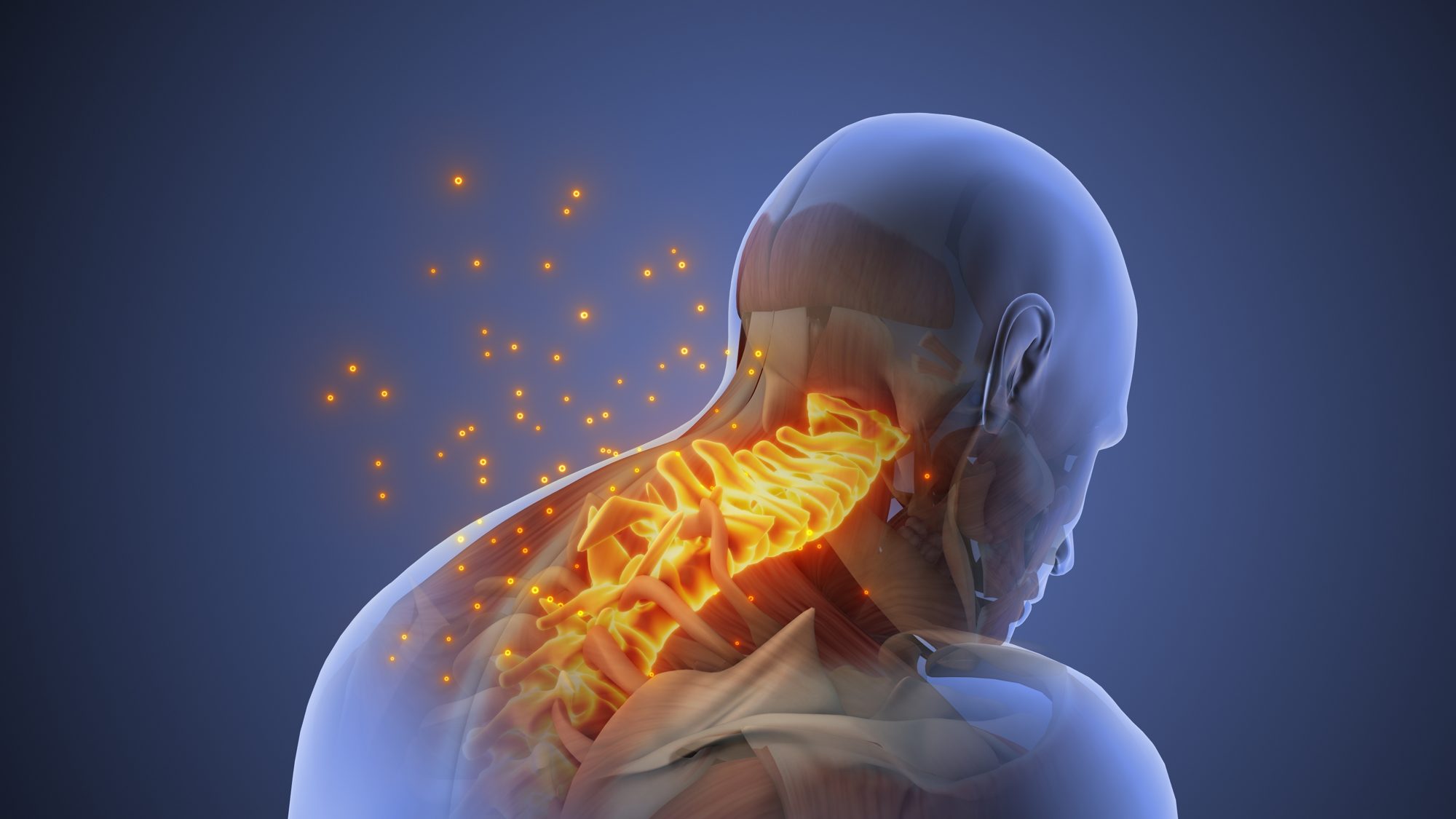
Cervical myelopathy is pressure on the spinal cord in the neck. It creeps up slowly, affects the hands and walking, and is the one neck condition where waiting can cost you function.
Cervical myelopathy care in Long Beach, with patients welcome from across South Bay, Orange County and the greater Los Angeles area.
Overview
What is cervical myelopathy?
The spinal cord carries every signal between the brain and the body. In the neck it passes through a canal that can narrow with age as discs bulge, ligaments thicken and bone spurs form. When that narrowing squeezes the cord, the cord itself begins to malfunction. That is cervical myelopathy, and it is the most common cause of spinal cord dysfunction in adults over 55.
Unlike a pinched nerve, which affects one arm, myelopathy affects everything below the neck: hand coordination, leg strength, balance and in later stages bladder control. Symptoms usually progress in steps, with periods of stability between declines. Because the cord does not repair itself, Dr. Bhalla's approach is to diagnose early and relieve the pressure before damage becomes permanent.
Causes
What compresses the cord
Several age related changes can combine to narrow the cervical canal.
Cervical spondylosis
General wear of the neck: bulging discs, bone spurs and thickened joints that crowd the canal.
Large disc herniation
A central herniation that presses on the cord rather than a single nerve.
Ossified ligament
The ligament behind the vertebral bodies turning to bone (OPLL), more common in people of East Asian descent.
Congenital narrow canal
A canal that was small from birth and reaches a critical size with less wear.
Instability or slippage
Vertebrae that move too much, or have slipped, pinching the cord with motion.
Injury
A neck injury that bruises an already compressed cord, sometimes after a minor fall.
Symptoms
What to watch for
The early signs are subtle and are often put down to aging. Together they form a pattern that should prompt an evaluation.
Common symptoms
- Clumsy hands: trouble with buttons, writing, coins or typing
- Numbness or tingling in the hands, often both
- Weak grip or dropping things
- Unsteady walking, a wide stance or needing to hold rails
- Stiff, heavy legs
- Neck pain, though it may be mild or absent
See a doctor right away if
- Rapid worsening of hand function or walking
- New bladder or bowel problems
- Falls
- Electric shock sensations down the spine when bending the neck
These can be signs of a problem that needs urgent care. Call (562) 427-8119 or go to the nearest emergency room.
Diagnosis
How we confirm it
Myelopathy is diagnosed by examination and confirmed by MRI. Catching it early depends on recognizing the signs.
01/Listen
Function over time
Changes in handwriting, fine tasks, walking distance and balance, and how fast they have appeared.
02/Examine
Cord signs
Brisk reflexes, specific hand and foot signs, gait testing and sensation. These findings are what separate myelopathy from a pinched nerve.
03/Image
MRI of the cervical spine
Shows how tightly the cord is squeezed and whether there is signal change within it. CT adds bone detail; X rays check alignment and stability.
04/Plan
Grade and decide
Dr. Bhalla grades the severity, explains the likely course and recommends monitoring or surgery accordingly.
Treatment
How it is treated
Very mild myelopathy can be monitored closely. Moderate or progressive myelopathy is treated surgically, because decompression is the only treatment that reliably stops decline.
First: without surgery
Where almost everyone starts
- Close monitoring with repeat examination for very mild, stable cases
- Physical therapy for balance and hand function
- Avoiding neck manipulation and high risk activities
- Fall prevention at home
- Pain management for neck symptoms
When needed: surgery
The least invasive option that will work
- Anterior decompression and fusion (ACDF) for one or two level compression from the front
- Cervical disc replacement in selected cases where motion can be preserved
- Laminoplasty or laminectomy and fusion for multi level compression from the back
- Neuromonitoring throughout to protect the cord

Everyday care
Protecting your spinal cord
Whether you are being monitored or have had surgery, these steps protect the cord and your independence.
- 01Report new hand clumsiness, numbness or unsteadiness right away.
- 02Avoid chiropractic neck manipulation while the cord is compressed.
- 03Make the home safer: rails, good lighting, no loose rugs.
- 04Keep legs strong and practice balance with a therapist.
- 05Protect your neck in cars and during sport until treated.
- 06Keep every follow up appointment so changes are measured, not guessed.
Questions
Things patients ask about cervical myelopathy.
If your question is not here, call the office. We are happy to talk it through.
Is cervical myelopathy the same as a pinched nerve?
No. A pinched nerve (radiculopathy) affects one nerve root and one arm, and usually improves on its own. Myelopathy affects the spinal cord itself, involves hands, legs and balance, and tends to progress without treatment.
Do I really need surgery if my symptoms are mild?
Mild, stable symptoms can sometimes be monitored. But myelopathy usually progresses in steps, and function lost during a decline may not return. Dr. Bhalla will give you an honest view of the risk of waiting in your specific case.
Will surgery give me back what I have lost?
Surgery reliably halts progression and many patients improve, particularly in pain, hand function and walking. Recovery is greatest when surgery is done before severe or long standing damage.
What is the recovery like?
Most patients are home within a day or two. Walking begins immediately. Hand function and balance improve over weeks to months, with therapy to support the recovery.
Near you
Cervical myelopathy treatment in Long Beach, CA
If you are living with cervical myelopathy in Long Beach or a nearby city, Dr. Bhalla can examine you, explain your options and plan the least invasive treatment that will work. Dr. Bhalla leads the Spine Center at MemorialCare Long Beach Medical Center.
Most people start with a consultation and imaging. Patients come from Signal Hill, Lakewood, Seal Beach, Orange County and across Southern California.
Patients come to us from
- Long Beach
- Signal Hill
- Lakewood
- Seal Beach
- Los Alamitos
- Cypress
- Bellflower
- Torrance
- Huntington Beach
- Carson
Not on the list? We see patients from across Southern California.
In the news
Dr. Bhalla on this topic.

Becker's Spine Review
Named one of the 150 best spine surgeons in America by Newsweek
Becker's Spine Review reported Newsweek's 2024 list of America's best spine surgeons. Dr. Bhalla is among the surgeons recognized.
June 12, 2024
MemorialCare
Improving patient outcomes with image guided spine surgery
On MemorialCare's Daily Dose of Wellness podcast, Dr. Bhalla explains how real time 3D navigation and robotics make spine surgery more precise and recovery faster.
November 25, 2024
Newsweek
Trust: How surgeons kept what health care lost
Newsweek's cover story on why patients still trust surgeons opens with Dr. Bhalla in his Long Beach office, talking about honesty, technology and the gift of being trusted.
June 12, 2024
Related services
How we treat it.
Non-Surgical Care
Evaluation, physical therapy, medication and targeted treatment first. Surgery only when it is truly the answer.
Learn more
Cervical Fusion
A proven operation for nerve and spinal cord pressure when the neck needs stability.
Learn more
Minimally Invasive Spinal Surgery
Small incisions, muscle-sparing tools and faster recovery for the neck and back.
Learn more